Tearing - BUGFIX! - Convert Δ' to the r_s reference length before slab-layer matching - #403
Tearing - BUGFIX! - Convert Δ' to the r_s reference length before slab-layer matching#403d-burg wants to merge 6 commits into
Conversation


Regression harness report —
|
Shaped-case check: shipped DIII-D-like SLAYER example (auto grid,
|
| q | k_ref | μ | K^(2μ) | Δ' raw | Δ' converted |
|---|---|---|---|---|---|
| 2 | 0.9125 | 0.540 | 0.9059 | 9.0969 | 8.2405 |
| 3 | 1.2245 | 0.529 | 1.2392 | −6.1961 | −7.6782 |
| 4 | 1.3597 | 0.558 | 1.4092 | −16.375 | −23.076 |
| 5 | 1.5051 | 0.831 | 1.9735 | −2475.3 | −4885.0 |
| 6 | 1.5502 | 0.521 | 1.5787 | −194.65 | −307.30 |
| 7 | 1.5541 | 0.504 | 1.5599 | 242.23 | 377.86 |
Notes for review:
- q=2 (the 2/1): −9.4 % in Δ'; with Δ_crit = 14.42 the effective drive moves −5.32 → −6.18. No sign changes on any surface (the q=2 flip threshold is 1.585).
- Shaping puts K > 1 outboard of q≈2.7, so the conversion amplifies |Δ'| at q ≥ 3 — this is why γ moved harder on outer surfaces in the regression report.
- q=5 has μ = 0.83 (strongly non-slab, D_I = −0.69); its ×1.97 factor is consistent bookkeeping, but the slab-layer match itself is a poor approximation at that surface regardless of convention.
🤖 Generated with Claude Code
Benchmark figures: Δ' alignment with TJ, before and after the K^(2μ) conversionFrozen TJ circular benchmark scans (q_edge = 3.6): TJ = hollow black rings (its own r_s-referenced Δ̂), julia_GPEC raw = dashed line (ψ_N-referenced BVP Δ', the pre-PR pairing), julia_GPEC ×K^(2μ) and Fortran STRIDE ×K^(2μ) = filled markers. K and μ are computed per point/surface from TJ's own equilibrium files — nothing fitted. Grey vertical band = pole region (each code approaches its own ideal-kink limit there; TJ's β-limit sits at p_f = 0.1675 vs 0.1851 for both STRIDE codes, so the comparison is not meaningful past the band edge).
Same data as percentage difference from TJ (grey horizontal band = ±3 % combined grid uncertainty of the two STRIDE codes):
Reading guide:
Figures live on the non-merging 🤖 Generated with Claude Code |


Same comparison on fixed grids: julia
|
| series | β roughness (med/max) | ε roughness (med/max) |
|---|---|---|
| julia auto@1e-3 | 1.38 % / 7.94 % | 0.91 % / 1.89 % |
| julia ldp@256 | 0.71 % / 2.45 % | 0.16 % / 0.60 % |
| fortran ldp@128 | 0.34 % / 1.75 % | 0.20 % / 1.57 % |
| fortran ldp@256 | 3.64 % / 6.83 % | 2.12 % / 10.24 % |
(The noise is a property of the auto grid's per-equilibrium adaptivity, not of the solver — julia's own fixed-grid series is the smoothest of the four. Fortran mpsi=256 is excluded from the figures because ldp knot oversampling above mpsi≈256 injects solver noise.)
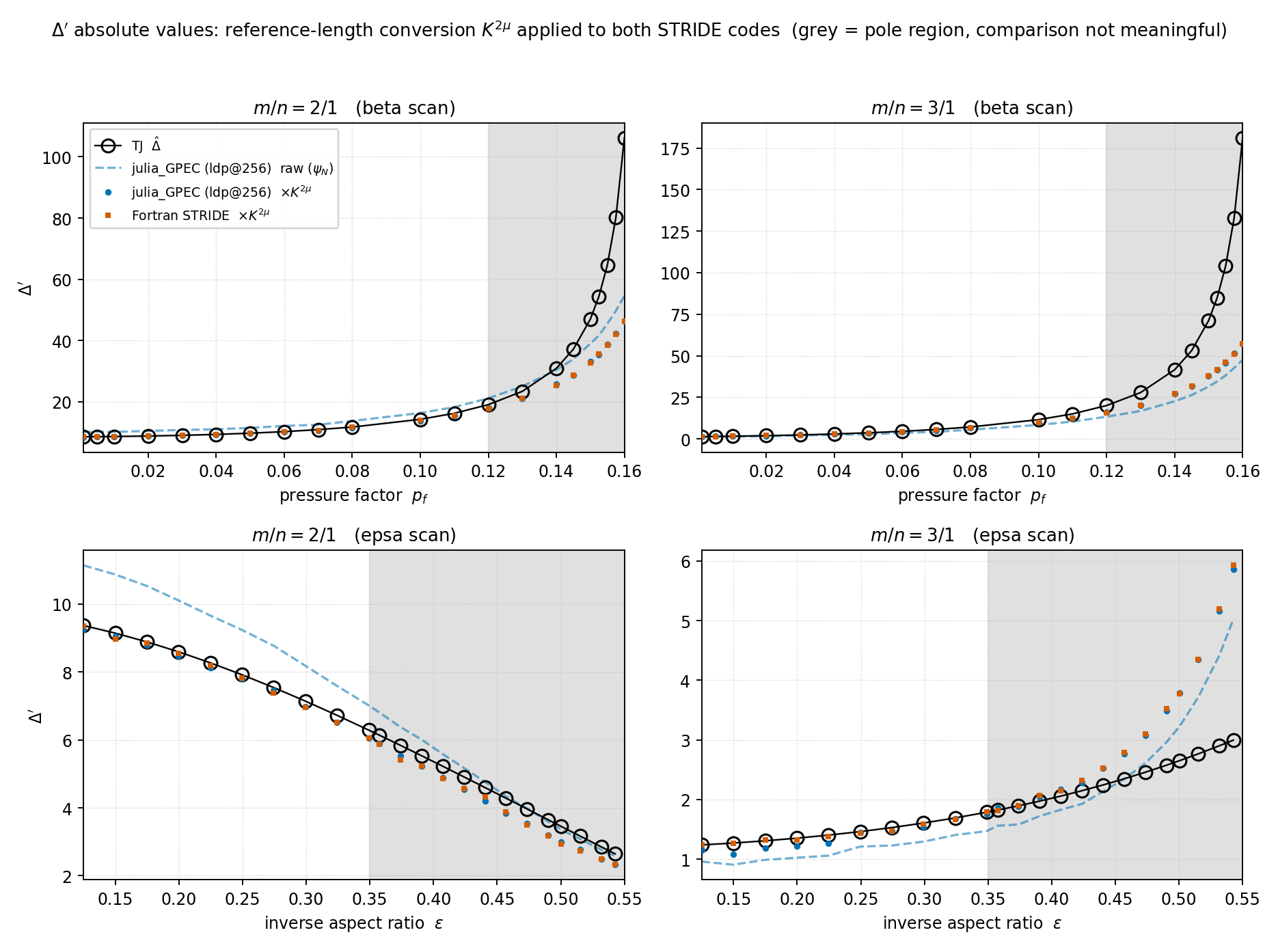

With the fixed grid, the corrected 2/1 medians are 1.4 % (β) and 1.4 % (ε) from TJ — spreads [−6.1 %, +0.2 %] and [−3.7 %, −1.0 %] — and the two STRIDE implementations are nearly indistinguishable point-for-point after the conversion. Median offsets are grid-robust (16.7–18.5 % raw across all four grid choices), so the K^(2μ) result is unchanged; only the scatter tightens.
Generated with JULIA_SRC=ldp via the same scripts (see PR body links).
🤖 Generated with Claude Code
|
Cross-reference: the "unexplained low-ε 3/1 drift" flagged in this PR's benchmark comments is now root-caused and fixed — it was a Riccati shooting error-control bug (#412, draft PR #413), not toroidal physics. With #413's branch the ε-scan 3/1 median |difference from TJ| after the K^(2μ) conversion drops 5.7 % → 2.3 % (see the scan-scale validation on #413), while the 2/1 panels here are unaffected (Δ'_21 moves ≤ 0.11 % across all 196 scan points). The two PRs are independent; merging #413 first and rebasing this branch is the suggested order. 🤖 Generated with Claude Code |

0cfee9d to
8315b5a
Compare
Rebased onto develop (
|
Radial-label unification (commit 06be788)A parallel investigation into a resistive-layer-overlap truncation criterion (psihigh cap, PR to follow; #298 context) independently ran into the same radial-label question this PR addresses, and the two efforts collided in
Findings on record from the cross-validation of the two investigations
Tests: LayerInputs 56 (incl. a five-label analytic-vs-FD derivative testset), Runner 79/79, params green. Regression harness refresh of 8315b5a -> 06be788 on NO MERGE WITHOUT HUMAN REVIEW — this PR remains a draft and requires a named human reviewer and assignee before it can be considered for merge. This is non-negotiable. |
Regression refresh: 8315b5a -> 06be788 (
|
| Quantity | Diff | Status |
|---|---|---|
| surface indices, m, n, minor radius rs | 0.0e+00 | OK |
| r-based shear | 6.0e-08 (0.00%) | changed |
| Lundquist S | 7.0e-02 abs (~1e-9 rel) | changed |
| D_norm | 3.1e-10 (0.00%) | changed |
| P_perp, tauk, iota_e | 0 / 5.5e-15 / 1.1e-16 | OK |
| Q_root [2/1,3/1,4/1] | 5.8e-06 | OK |
| omega_Hz | 1.9e-01 | OK |
| gamma_Hz | 1.5e-01 (0.01% max element) | changed |
| no_root flags, enabled | 0.0e+00 | OK |
Interpretation: rs is bit-identical (the default :midplane radius formula is untouched); the 1e-8-1e-9 relative movement in shear/S/D_norm is precisely the h^2 ~ 1e-10 truncation error of the removed finite-difference stencil, i.e. the analytic derivative correcting the FD approximation, and it amplifies to at most 0.01 percent in the extracted growth rates through root-finding. The refactor is inert at defaults to within the old stencil's own numerical noise. No tolerance or acceptance criterion was changed anywhere in this commit.
Post-hoc annotation: the omega_Hz (1.9e-01) and gamma_Hz (0.01%) lines in this table were later found to be contaminated by a harness cached-sample artifact (see the forced-rerun verification comment below) and are upper bounds, not measured effects; the true effect of the derivative swap is at or below the ~1e-5 Hz sample-noise ceiling. The interpretation paragraph's conclusion (inert at defaults) stands, conservatively.
d-burg
changed the title
 github-actions
Bot
added
bugfix
github-actions
Bot
added
bugfix
|
Forced-rerun verification of the regression stamp. A harness caching subtlety was found today: the results DB keeps one cached sample per commit ( To rule it out for this PR, the stamped One earlier comment in this thread needs a precision note: the intermediate |
06be788 to
baf6746
Compare
Closing summary: per-surface effect on the reference DIII-D-like equilibriumDirect base-vs-head runs of
What to read from it
Other changes in this PR worth noting for review
NO MERGE WITHOUT HUMAN REVIEW — this PR requires approval from its named reviewers (logan-nc, matt-pharr). Non-negotiable. |


|
@d-burg the requested reviewers are not available → assigning @ebursch. Please post confirmation that this is ready to review and provide a synthesis/guide for him as this is possibly an overwhelming wall of text in the PR comments rn. An artifact with workflows and figures, as per the claude.md instructions I shared earlier, would probably be quite helpful here. @ebursch - you got this! |


…b-layer matching

The SLAYER dispersion relation paired a ψ_N-referenced BVP Δ' with an
r_s-referenced layer side (Δ(Q), S=τ_R/τ_H on r_s, and the critical-Δ,
whose Ŵ_d is W/r_s). Apply the Frobenius reference-length transform
Δ̂_ij = K_i^(1/2+μ_i)·Δ'_ij·K_j^(μ_j−1/2), K = r_s·(dψ_N/dr)|_s,
μ = √(−D_I), at the matching point. Verified parameter-free against the
TJ circular benchmarks (median residual +1% over 23 points; absolute
2/1 agreement 17.5%→2.5% (β) and 17.6%→1.1% (ε)). BVP Δ' outputs are
unchanged; only the SLAYER matching (γ, Δ_eff) moves. GGJ untouched.

Co-Authored-By: Claude Opus 5 <noreply@anthropic.com>
…el options to build_slayer_inputs

The cylindrical layer model needs a single minor radius; on a shaped
torus that label is ambiguous. Add rs_method options :halfwidth
(midplane half-chord, the shift-free stand-in for the circular-theory
flux label; reproduces it to ~1% on circular benchmarks) and :volume
(cylinder-equivalent √(V/2π²R₀), the Rutherford-literature convention)
alongside the existing :midplane default and :fsa. Every label feeds
S, the r-based shear, W_d, and k_ref together, so each choice is
self-consistent by construction. Programmatic API only — not exposed
via TOML; the default and all TOML-driven results are unchanged.

Co-Authored-By: Claude Opus 5 <noreply@anthropic.com>
…nd unify the label plumbing

Factor the rs_method radial-label options out of build_slayer_inputs into one
exported radial_label(equil; rs_method, theta) returning (r, dr/dpsi) closures,
and add a fifth label :flux — Fitzpatrick's toroidal-flux surface label
(Nucl. Fusion 2025, Eq. 30), r = sqrt(2 psi_t / B0) with the g = F/(B0 R0)
correction carried. All five labels now use analytic psi-derivatives from the
interpolants themselves; the finite-difference stencils (which silently clamped
within 1e-4 of the flux boundaries) are removed. The :fsa branch gains the
max(r^2, 0) guard needed on extrapolated surfaces.

k_ref and the K^(2mu) Delta-prime conversion consume the same closures, so the
label choice drives S, the r-based shear, W_d and the Delta-prime reference
length together for every option. Default :midplane behavior is unchanged up to
the analytic-derivative refinement. Shared infrastructure for the resistive
layer-overlap psihigh cap branch, which evaluates its criterion in :flux.

Co-Authored-By: Claude Fable 5 <noreply@anthropic.com>
…actor against unusable da/dpsi

The k_ref guard tested only for an exact zero, so a non-finite da/dpsi (reachable where
the interpolant's r^2 is clamped non-positive on extrapolated surfaces) silently zeroed
the converted Delta' diagonal, and a negative one raised DomainError from the non-integer
exponent. Fall back to the identity conversion with a warning instead.

Also corrects the Mercier-unstable comment: clamping mu to 0 leaves only the diagonal raw
and discards a genuine phase, since the exponents are 1/2 +/- i|mu| there.

Co-Authored-By: Claude Opus 5 <noreply@anthropic.com>
baf6746 to
29df870
Compare
Rebased onto develop
|
| Quantity | previous stamp 8f4be5fe→baf67465 |
now d7e6e6fe→29df8700e |
|---|---|---|
| SLAYER r-based shear | 6.009e-08 | 6.009e-08 |
| SLAYER Lundquist S | 6.967e-02 | 6.967e-02 |
| SLAYER D_norm | 3.127e-10 | 3.127e-10 |
| SLAYER Q_root | 8.892e-03 (1.27%) | 8.889e-03 (1.27%) |
| SLAYER ω_Hz | 1.143e+01 (0.10%) | 1.143e+01 (0.10%) |
| SLAYER γ_Hz | 3.318e+02 (42.16%) | 3.317e+02 (42.14%) |
diiid_n1_riccati |
17/17 unchanged | 17/17 unchanged |
The signature is unchanged, which is the point: diiid_n1_riccati is still bit-identical across all 17 quantities including the BVP Δ' diagonal and the raw side-major matrix, so #419 and the MatrixSplines break do not interact with this PR. The residual γ wobble (42.16 → 42.14 %) is the ~1e-5 Hz root-search sample noise tracked in #418.
One caveat on the record: the manifest here (638da0a2) is a fresh resolve on this machine, not the 7e5c34ad of the original stamp. Both sides share it so the A/B is valid, but it is a different package set than the earlier runs in this thread.
One code change in the rebase (29df8700e): the k_ref guard tested only for an exact zero. A non-finite da/dψ — reachable where the interpolant's r² is clamped non-positive on extrapolated surfaces — would have silently zeroed the converted Δ' diagonal, and a negative one would raise DomainError from the non-integer exponent. It now falls back to the identity conversion with a warning. Provably inert on this deck: rs is bit-identical and the dispersion diffs above match the old stamp to three significant figures.
Also corrected the Mercier-unstable comment. Clamping μ to 0 leaves only the diagonal raw — the off-diagonals still carry K_i^(1/2)·K_j^(−1/2) — and since the exponents are 1/2 ± i|μ| there, it discards a genuine phase rather than taking a continuous limit.
Previous head baf674659 is preserved locally if anyone needs to diff against it.
Jacobian audit of the radial labels:
|
| label | spread in r_s |
spread in dr/dψ |
verdict |
|---|---|---|---|
:midplane (default) |
≤ 1.3e-16 | ≤ 3.0e-14 | exactly invariant |
:volume |
≤ 6.7e-10 | ≤ 9.8e-09 | invariant (quadrature noise) |
:flux |
≤ 6.9e-10 | ≤ 9.9e-09 | invariant (quadrature noise) |
:halfwidth |
1.5e-4 … 3.6e-4 | 1.4e-2 … 3.8e-2 | coordinate-dependent |
:fsa |
3.8e-2 … 6.6e-2 | 5.9e-2 … 1.45e-1 | coordinate-dependent |
The cause is the same in both: they average over the coordinate's θ with a uniform measure. :fsa is a 128-point uniform mean, which is a true flux-surface average only if the jacobian is already uniform in θ — so it silently inherits whatever θ-packing the coordinate system has, and moves r_s by up to 6.6 % and dr/dψ by up to 14.5 % on nothing but a jac_type change. :halfwidth assumes θ = 0.5 is the inboard midplane, which is not true in every coordinate.
The three labels defined from flux alone — :midplane (a single θ = 0 chord), :volume, :flux — are clean, and the default is unaffected. But the name :fsa claims a flux-surface average it does not compute, and its docstring currently advertises it as "the closest geometric approximation to :flux at interior surfaces" with no warning that the approximation depends on jac_type.
Suggested resolution (not in this PR unless reviewers want it here): either weight the mean by the jacobian to make it a genuine FSA, or rename it and document both it and :halfwidth as coordinate-dependent conventions not to be used for Fitzpatrick-formalism quantities.
|
@logan-nc ready to review — rebased onto the develop tip and re-stamped the regression on it (comment above); the previous evidence predated #419 and #383. @ebursch — a reading order so you can skip the archaeology. What the bug is. The dispersion relation The fix, in one line. The four things worth your scrutiny, in order:
What you can skip: everything about the radial-label options ( Caveat you should know going in: the TJ benchmark that carries claim (2) lives in a private repo, so it is not reproducible from this PR. The in-repo tests verify the transform's algebra against its own formula and would pass identically if the exponents were physically wrong. If that is not good enough, say so and we will land a reproducible artifact. |
Co-Authored-By: Claude Fable 5 <noreply@anthropic.com>
|
@ebursch — per @logan-nc's suggestion, a self-contained synthesis of this PR so you can skip the thread archaeology: the reference-length mismatch as a picture, the K^(2μ) derivation, the TJ benchmark before/after, the per-surface effect on the shipped deck, and the radial-label audit, ending in a checklist of what to verify independently. https://claude.ai/code/artifact/af31c362-8129-473b-824e-94d3df982559 |
2 participants


Release note
k_ref,mu_mercier, anddelta_prime_conversiondatasets documenting the transform, and theDelta_prime_matrixlong_name notes the r_s reference.SLAYER's dispersion relation compared the outer-region Δ' (referenced to unit ψ_N) against layer quantities referenced to the minor radius r_s, overstating or understating growth rates surface-by-surface. Δ' is now converted to the r_s reference length via the Mercier-exponent K^(2μ) transform before slab-layer matching, and the radial label defining r_s (five options, including Fitzpatrick's toroidal-flux label) is selectable programmatically, with the historical midplane default unchanged.
Regression report
regress --cases diiid_slayer_n1,diiid_n1_riccati --refs e09795119,63dcc8113 --force(develop tip vs branch head, raw shas so no stale local-branch resolution, both sides force-re-run so neither comes from the results cache; same pinned manifest, julia 1.11.6):The moved quantities are exactly the intent: the dispersion roots move because Δ' now enters the layer matching in the r_s reference. The 1e-8–1e-9 relative movement in shear/S/D_norm is the truncation error of the finite-difference stencil this branch replaces with analytic interpolant derivatives, not a physics change.
diiid_n1_riccatiis bit-identical throughout, including the Δ' BVP diagonal and raw matrix — this PR converts Δ' downstream of the outer-region solve and does not perturb it. No tolerance or acceptance criterion was altered.Summary
The SLAYER tearing dispersion relation
Δ' − Δ_crit = S^{1/3}Δ̂(Q)mixed two reference-length conventions: the outer BVP Δ' is referenced to unit Δψ_N (STRIDE convention), while every term on the layer side — the Fitzpatrick slab Δ(Q), the Lundquist numberS = (μ₀r_s²/η)/τ_H, and therfitzp/lar/toroidalcritical-Δ — is referenced to unitx̂ = (r−r_s)/r_s. This PR converts Δ' to the r_s reference at the matching point:whose diagonal is
K^(2μ)·Δ'_kk, reducing to the textbookΔ̂ = r_s·Δ'_physat the slab point D_I = −¼. K and μ are computed per surface from the equilibrium (surface_minor_radius/surface_da_dpsi, GGJ E+F+H−¼ fromResistGeometry).Why this is correct
A_L|x|^(1/2−μ) + A_S|x|^(1/2+μ)(Glasser, Wang & Park 2016, Eq. 26); rescalingx_ψ = K·x̂mapsÂ_L = A_L K^(1/2−μ),Â_S = A_S K^(1/2+μ), giving the transform above.Ŵ_d = W_d/r_s(proven by its source multiplying the reported width by r_s to convert to a-units), its Δ carriesr_s^(1+2ν)by definition (its docs' pressure-flattening derivation,1+2ν = 2μ), and its dispersion assembly(Δ − Δ_c)/S^{1/3}is identical in form to ours. Thedc_tmpformulas inLayerParameters.jlare a line-for-line port of that r_s-referenced formula set.K^(2μ)computed from TJ's own equilibrium files reproduces the measured Δ̂_TJ/Δ'_GPEC ratio to +1 % median over 23 pole-free points; in absolute values the 2/1 median |difference from TJ| drops 17.5 % → 2.5 % (β) and 17.6 % → 1.1 % (ε), inside the combined grid band. The factor is 0.84 at the 2/1 but 1.20 at the 3/1, and raw GPEC was correspondingly +18 % high / −28 % low — one formula corrects both directions.What changes numerically
SingularSurfaces/Delta_prime_matrixstays ψ_N-referenced; STRIDE benchmarking is unaffected.Tearing/PerSurface/Delta_prime_matrixnow stores the r_s-referenced matrix actually used in the matching (long_name updated), plus new per-surface datasetsk_ref,mu_mercier,delta_prime_conversion.rescale_deltahandles inner→outer units natively).SLAYERParametersdefault tok_ref = 1→ identity conversion, so existing unit tests andrun_slayer_from_inputsworkflows are unaffected unless the caller opts in.Changes
SLAYERParameters: new fieldsk_ref,mu_mercier(documented; default 1.0/0.5 = identity).build_slayer_inputs: fills both from the equilibrium; Mercier-unstable surfaces (D_I ≥ 0) get μ → 0 continuously (Δ' left raw) — documented in-line.run_slayer_from_inputs: appliesdelta_prime_to_rs_reference(new, documented) for the slab-layer path.surface_couplingdocstring corrected:S^{1/3}maps the inner Δ to the r_s-referenced outer convention, not "ψ-units" — the previous wording was the error that concealed this mismatch.Tearing/PerSurfacedatasets + annotations;SLAYERResult.dp_matrixdocstring notes the convention.K^(2μ), off-diagonal split factors, slab-point reduction toK, identity default).Validation
developvs this branch: only the SLAYER dispersion roots moved (γ up to 42.14 % max-element; ω 0.10 %); all layer inputs and all 17 Riccati/BVP quantities (incl.SingularSurfaces/Delta_prime_matrix) bit-identical — current tables above; earlier full reportBenchmark figures and the full theory audit (TJ source citations, ratio test, corrected Δ' comparison plots) are recorded in the maintainer's private benchmark repo: issue · figures + scripts (maintainer access).
Important
This changes every SLAYER γ (≈9 % shift in Δ_eff at q=2 on the shipped example). Do not merge without human review of the derivation and the regression report.
🤖 Generated with Claude Code