






I build working AI systems for regulated clinical research, and I teach the people around me to run them. My focus is making AI safe and usable on protected health data, where the engineering has to be careful and the people using it are experts in their field rather than in AI.
Currently: Research Teaching Specialist III, Rutgers University (US-India RePORT tuberculosis research consortium) Based in: Chester, VA · Open to relocation Studying: M.S. Cybersecurity and Information Assurance, Southern Utah University Open to: privacy engineering and applied AI roles building fail-closed systems for regulated data


- Build AI assistants that work on sensitive health data without exposing patient information.
- Turn slow, technical data tasks into natural-language tools researchers can run themselves.
- Train non-technical teams to adopt AI tools confidently and independently.
- Build reproducible, auditable research software with the controls and evidence regulated work requires.
Longer term, I work toward post-quantum cryptography readiness and crypto-agility for sensitive-data systems.
Flagship project: PHI-Handling-system
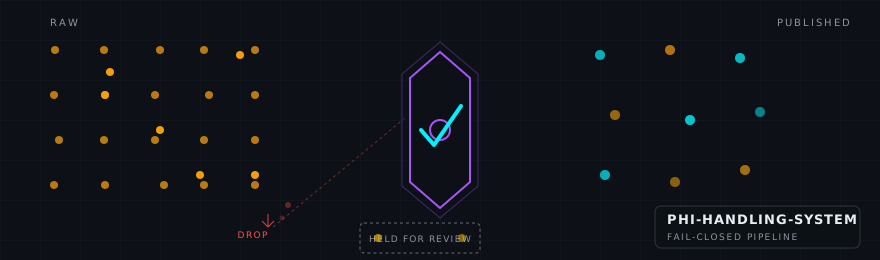
A fail-closed pipeline that turns raw clinical study data into something an AI assistant can safely query. Upload a ZIP of datasets, forms, and dictionaries, and the Judge classifies every column with one of three verdicts: keep it as-is, drop it, or apply a Safe Harbor transformation. The LLM only ever sees column headers, dictionary text, and form fields, never a patient row. A sandboxed executor applies the transformations, a deterministic verifier checks the result, and a residual PHI guard scans everything before it can publish. Anything it cannot classify with confidence holds the whole study rather than being silently dropped or guessed at.
- 11-stage documented pipeline, from intake through publish guard
- 340+ regression tests
- Source data is symlinked in, never copied or modified
- Documents its own known limitations, like a disclosed weak-fallback path, instead of hiding them
- QI Stat Studio: a guided statistics app that lets Rutgers IM Clinic medical residents run quality-improvement analyses on their own data, from upload to a shareable report, without needing a statistics background.
- Amarel VS Code: a VS Code Remote-SSH setup tool for Rutgers' Amarel HPC cluster, fixing the GLIBC 2.28 compatibility error on macOS and Windows.
- BatchQC: my first project, 72 commits to the R/Bioconductor package for batch-effect evaluation of high-throughput genomic data. NIH-funded, bioRxiv preprint 2026.






I work across Claude, OpenAI, Google, and local models, with RAG, prompt engineering, and evaluation harnesses under Model Context Protocol and LangGraph.

Ask me about pseudonymization. Just don't ask who I really am.
Reach me at LinkedIn or solomonjosephusa98@gmail.com.
Public repositories here contain no real PHI or patient data. Any PHI or PII examples are synthetic or sanitized.