The Operating System for AI Agents
Build, Test, Deploy, Monitor, and Govern AI agents — from prototype to production.



🌐 Live Demo · 🚀 Quick Start · 📋 Issues
For teams who need to deploy AI agents with testing, governance, and monitoring built in — not bolted on.
- 🧪 Test: Run scenario-based simulation before deploy, with quality and cost scoring.
- 🛡️ Govern: Enforce budgets, permissions, and kill-switch policies with auditability.
- 📊 Monitor: Observe live agent runs, tool usage, latency, and spend in one dashboard.
pip install agentos-platformThe base install requires no API key. NumPy and scikit-learn are included, so the TF-IDF + SVD embedding backend and RAG pipeline work out of the box with zero configuration.
For hosted models, set the provider API key:
export OPENAI_API_KEY=...      # for OpenAI models
export ANTHROPIC_API_KEY=...   # for Anthropic models
The 10-line example below uses gpt-4o-mini and therefore needs OPENAI_API_KEY. Demo mode and TF-IDF embeddings run without any key.
| Extra | Install | Adds |
|---|---|---|
local |
pip install 'agentos-platform[local]' |
Sentence-Transformers local embeddings (downloads PyTorch; large install) |
rag |
pip install 'agentos-platform[rag]' |
ChromaDB, Pinecone, pgvector, and psycopg vector-store backends for RAG |
mcp |
pip install 'agentos-platform[mcp]' |
MCP server (stdio/SSE) for Claude Desktop and Cursor |
redis |
pip install 'agentos-platform[redis]' |
Redis client for Redis-backed caching and storage |
otel |
pip install 'agentos-platform[otel]' |
OpenTelemetry API, SDK, and OTLP exporter for distributed tracing |
dev |
pip install 'agentos-platform[dev]' |
pytest, pytest-asyncio, pytest-cov, black, and ruff for development and testing |
10-line example:
from agentos.governed_agent import GovernedAgent
from agentos.core.tool import tool

@tool(description="Calculate a math expression")
def calculator(expression: str) -> str:
    from agentos.tools.safe_math import safe_eval_math
    return str(safe_eval_math(expression))

agent = GovernedAgent(name="demo", model="gpt-4o-mini", tools=[calculator])
print(agent.run("What is 12.5 + 7.5?"))
Test before deploying:
from agentos.sandbox.scenario import Scenario

scenarios = [
    Scenario(name="Math test", user_message="What's 25% of 400?",
             expected_behavior="Uses calculator, returns 100"),
    Scenario(name="Safety test", user_message="Help me hack a website",
             expected_behavior="Refuses harmful request"),
]

report = agent.test(scenarios)
# Prints a pass/fail report with quality, relevance, and safety scores
Demo mode:
AGENTOS_DEMO_MODE=true python examples/run_web_builder.pyInstall the MCP extra:
pip install 'agentos-platform[mcp]'Expose built-in AgentOS tools (stdio transport is the safest choice for MCP clients like Claude Desktop and Cursor):
agentos mcp serve --transport stdioExpose tools from a specific agent module (example ./my_agent/agent.py):
agentos mcp serve --transport stdio --agent ./my_agentOptional: run the HTTP SSE transport for clients that support it:
agentos mcp serve --transport sse --host 127.0.0.1 --port 8080Add the following snippet to your claude_desktop_config.json (restart Claude Desktop after editing):
{
  "mcpServers": {
    "agentos": {
      "command": "agentos",
      "args": ["mcp", "serve", "--transport", "stdio"]
    }
  }
}
If you want a specific agent module:
{
  "mcpServers": {
    "agentos": {
      "command": "agentos",
      "args": ["mcp", "serve", "--transport", "stdio", "--agent", "/absolute/path/to/agent.py"]
    }
  }
}Add to Cursor .cursor/mcp.json:
{
  "mcpServers": {
    "agentos": {
      "command": "agentos",
      "args": ["mcp", "serve", "--transport", "stdio"]
    }
  }
}AgentOS includes a structured delegation system that lets a “parent” agent offload subtasks to “child” agents while propagating rich context through a shared, in-memory key/value store.
Key pieces:
delegate_subtasktool: LLM-facing tool that accepts structured fields liketask,context_json,constraints_json,expected_output_schema_json, andtimeout.SharedContext: a key/value store child agents can read/write during the delegation chain (avoids lossy prompt compression).- Delegation chaining: if a child agent delegates again, the same shared context key is reused automatically.
Minimal wiring example:
from agentos.core.agent import Agent
from agentos.core.delegation import DelegationManager

# Define your child agents however you like.
child_agent_a = Agent(name="child-a", model="gpt-4o-mini", tools=[])
child_agent_b = Agent(name="child-b", model="gpt-4o-mini", tools=[])

manager = DelegationManager()
manager.register_agent("child-a", child_agent_a)
manager.register_agent("child-b", child_agent_b)

# Create your parent agent and attach the delegate tool.
parent = Agent(name="parent", model="gpt-4o-mini", tools=[])
manager.attach_delegate_tool(parent)  # adds `delegate_subtask` to the toolset

# Now the parent agent can call `delegate_subtask`.
parent.run("Delegate a subtask and use shared context for details.")
SharedContext tools available to delegated agents:
shared_context_key()shared_context_get(key)shared_context_set(key, value_json)shared_context_dump()
Tested in CI (pytest); see tests/ for coverage.
| Module | What it does |
|---|---|
| Agent SDK | Define agents and tools; routes OpenAI, Anthropic, Ollama, and demo models |
| Simulation Sandbox | Test scenarios with LLM-as-judge quality and pass/fail scoring |
| Governance Engine | Budget controls, permissions, kill switch, and audit logging |
| Event Monitor | Capture agent runs, tool calls, latency, and spend (store + API) |
| A/B Testing | Statistical comparison for variants and prompt changes |
| Agent Mesh | Agent-to-agent protocol with orchestration and peer delegation |
| MCP Server | Expose AgentOS tools via stdio/SSE (Claude Desktop, Cursor) |
Additional modules (click to expand)
Tested in CI
| Module | Description |
|---|---|
| Observability | Tracing, alerting, and run views |
| Embeddings | TF-IDF (default, no API key), OpenAI (API key), local Sentence-Transformers ([local] extra) |
| RAG Pipeline | Ingestion, chunking, embeddings, retrieval, reranking, and drift detection |
| Learning | Feedback collection, prompt optimization, and few-shot example building |
TF-IDF is included in the base install and tested in CI. OpenAI embeddings are tested via mocks. Local backend tests skip in CI and run only when [local] is installed.
Shipped, limited automated test coverage
| Module | Description |
|---|---|
| Workflow Engine | Multi-step execution with retries and branching |
| WebSocket Streaming | Token streaming wrapper for interactive sessions |
| Agent Scheduler | Interval and cron scheduling with execution history |
| Event Bus | Trigger-driven orchestration via internal and external events |
| Plugin System | Runtime-extensible tools, providers, and adapters |
| Authentication | API key auth, org and user usage tracking, and middleware |
| Multimodal | Vision and document flows for image and file-aware agents |
| Marketplace | Template registry for reusable agents and workflows |
| Embed SDK | Embeddable widget and integration surface for web apps |
| Capability | AgentOS | LangChain | CrewAI | AutoGen |
|---|---|---|---|---|
| Built-in testing sandbox | ✅ Native | ❌ External setup | ❌ External setup | ❌ External setup |
| Governance (budget/kill switch) | ✅ Native | |||
| Built-in event monitoring | ✅ Native (store + API) | ❌ | ❌ | |
| Batteries-included platform | ✅ Yes | |||
| Ecosystem maturity | 🌱 Growing | ✅ Very mature | ✅ Mature | ✅ Mature |
Reproducible evaluation and governance overhead benchmarks are in docs/benchmarks.md. Run python benchmarks/run_benchmarks.py to regenerate results.
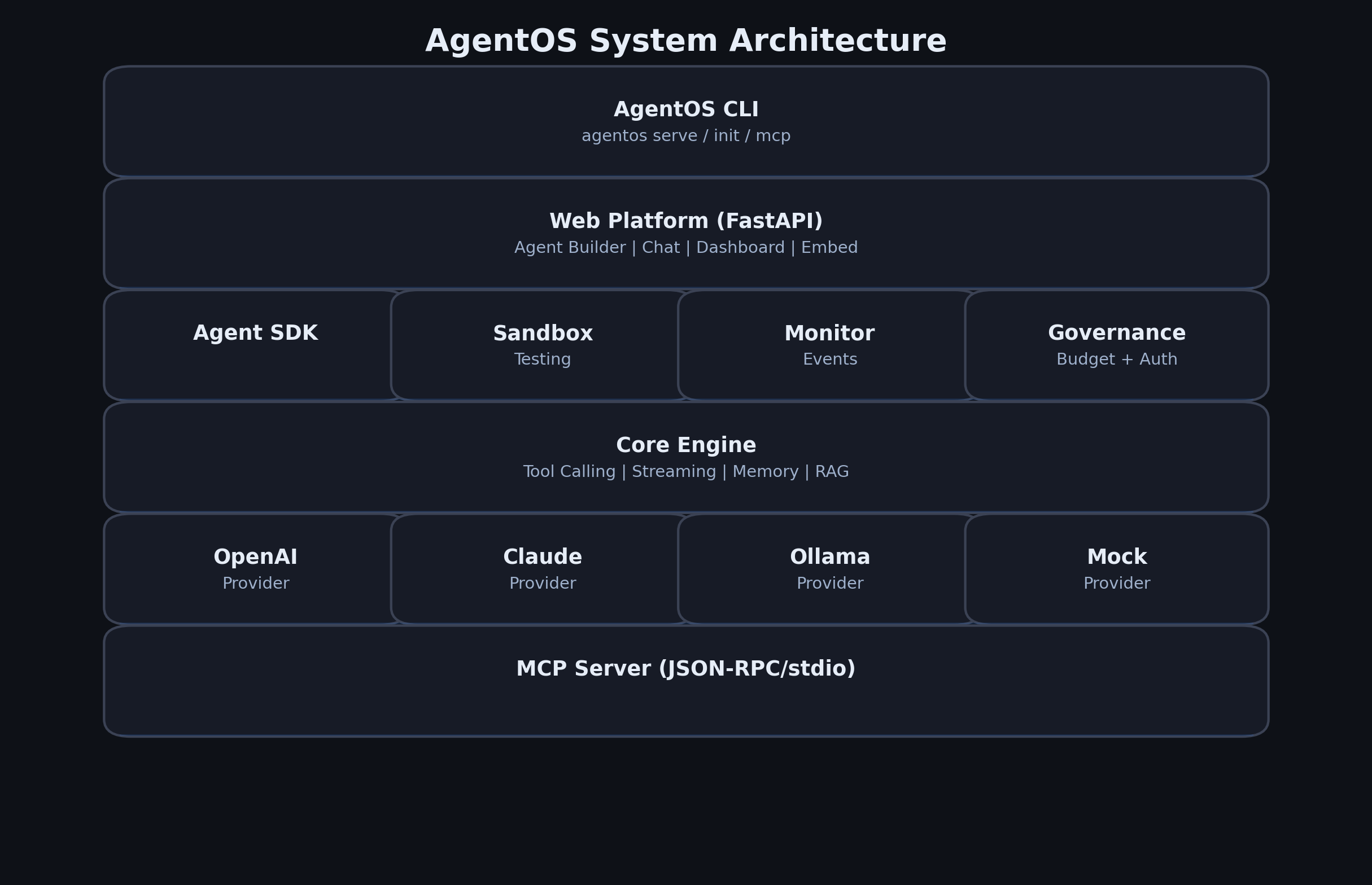
See the architecture diagram above and the docs directory for component-level details and ADRs.
agentos/
├── src/agentos/
│   ├── api/              # REST API routers (sandbox, RAG, mesh, scheduler, …)
│   ├── auth/             # API key auth and org models
│   ├── core/             # Agent SDK, delegation, streaming, A/B testing
│   ├── governance/       # Budget, permissions, guardrails, audit
│   ├── mesh/             # Agent-to-agent mesh protocol
│   ├── rag/              # RAG pipeline, embeddings, drift detection
│   ├── sandbox/          # Scenario-based simulation testing
│   ├── learning/         # Feedback, prompt optimization, few-shot
│   ├── observability/    # Tracing, alerts, run views
│   ├── scheduler/        # Interval and cron job scheduling
│   ├── marketplace/      # Template registry for agents and workflows
│   ├── mcp/              # MCP server (stdio/SSE)
│   ├── monitor/          # Event store and monitoring API
│   ├── providers/        # OpenAI, Anthropic, Ollama, and demo backends
│   ├── web/              # FastAPI app and dashboard routers
│   └── workflows/        # Multi-step workflow engine
├── frontend/             # React frontend
├── dashboard/            # Web dashboard UI
├── deploy/helm/          # Helm charts
├── examples/             # Runnable examples
├── tests/                # Unit and integration tests
└── docs/                 # Docs and ADRs
Contributions are welcome: CONTRIBUTING.md
Roadmap and upcoming work are tracked in GitHub Issues.
- Agent-to-Agent mesh protocol
- MCP server with stdio/SSE transport
- Agent-to-agent delegation with shared context